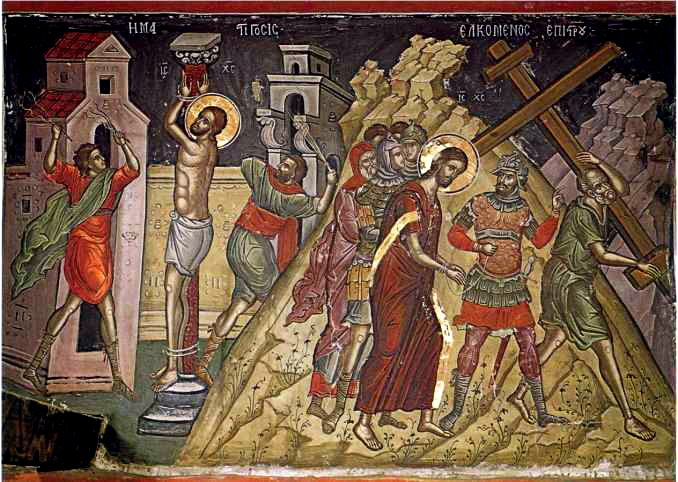
Homily - Holy Thursday The Mass of the Lord's Supper


Homily (Sermon)

The Easter Triduum - Thursday

“I have given you an example so that you may copy what I have done to you.”


The Readings for Holy Thursday The Mass of the Lords Supper:

Exodus 12:1-8, 11-14
Psalm 115
1 Corinthians 11:23-26
John 13:1-15


[These readings can be found at www.universalis.com for the next few weeks, remember to scroll down a little as this link also contains the readings for the Chrism Mass.]


The Passover meal is one of the biggest feasts of the year for the  Jewish people. It is a time for the people of Israel to give thanks for their salvation. To remember the night they were saved from slaver. To remember how the Lord went through Egypt and passed over their houses. How the Lord struck down the first born of every Egyptian family and animal.

There is a pattern here you might notice. We tonight gather to celebrate a meal, another Passover meal but not the original Passover meal celebrated by the Jewish people, but the Lord’s Supper, the last meal our Lord ate.

Christ was celebrating with his friends, the disciples, the saving act of God in freeing His people from slavery under the Egyptians, as we here, are celebrating the saving act of God freeing us from slavery to sin.

The nation of Israel was saved by the death of the first born sons of Egypt. We are all saved through the death of God’s first and only son, Jesus.

Every time we take part in the Mass, every time we receive Christ’s body and blood, every time we join our heart to His during communion we also take a seat at Christ’s table at the last supper.

We witness Jesus our Lord and Master wash the feet of his disciples. We see a powerful demonstration of the call to serve, the foundation of the priesthood, the foundation of our ministries and our service.

The washing of feet was a servants job. It was also the act of welcome into a house. As Christ washed their feet he showed them they were servants, he also welcomed them into his house, into his fathers house.

In a few moments you will witness Fr Kevin wash the feet of some of you. We are all disciples of Christ and as we watch this beautiful and touching at of service we must hear and take into our hearts Christ’s words. “I have given you an example so that you may copy what I have done to you.”

Will you take this image away with you and let it lead you to serve others? The disciples founded our church, what will you do? Who will you be welcoming into God’s house with your service?

This Easter, this Triduum, open your heart to Christ. Stay and pray with Him tonight. Stand at the foot of His cross tomorrow. Joyously offer praise and glory to Him as His light returns to the World on Easter Sunday.

Take Christ as your example, you are His disciples, you are His royal Priesthood, You are now the servant He is sending to a world that very much needs you to wash it’s feet.


Homily Index


Homily - Good Friday - The Celebration of the Lord's Passion


Homily (Sermon)

The Easter Triduum - Good Friday

“It is accomplished" and bowing his head he gave up the spirit.


The Readings for Good Friday - The celebration of the Lord's passion:

Isaiah 52:13 -53:12
Psalm 30
Hebrews 4:14-16, 5:7-9
John 18:1 – 19:42

[These readings can be found at www.universalis.com for the next few week.]

Easter has been simplified and commercialised by the world around us. The rich history, the thousands of years of tradition, the mystery of Easter is lost, drowned out by bunnies, eggs and chocolate.

Mystery is an interesting word; do you know what it means?
It can mean a puzzle, something unknown, it can also be a type of novel like those written by Agatha Christie, but when we use it to describe the paschal mystery then it doesn't mean something we don’t know, it means almost the opposite, it means “a truth that is unknowable except by divine revelation.”

Easter is divine revelation! Easter is God showing Himself to us!

At Easter we join Christ as we celebrate his passion, death and resurrection. God is revealing to us a truth, a powerful truth, the single truth, Himself. Yesterday we met Christ at the last supper, we traveled with Him to the garden of Gethsemane, we waited with Him and prayed with Him and tried to stay awake with Him.

Today we die with Him. Today is quiet day. A day to reflect on death.A day to reflect on our sin. A day to reflect on where we would be if Christ was not in our lives. Today we reflect on the great sacrifice Christ made for us. On the things in our lives that required Him to make that sacrifice for us. Today we die with Christ, we die to sin, we suffer with Him, we look to the crosses in our own lives that we must bear.

Tomorrow we will see, know, and feel the full mystery, the revelation. But for now it is Christ’s death that is important. We call today Good Friday. I am often asked why it is good. It’s good because Christ, God’s Son, High Priest came to offer a permanent sacrifice for our sins. He needed to sacrifice something perfect; something so opposite to sin and the only thing that fitted that description was Himself. Christ took the role of High Priest and the role of sacrifice. He offered Himself for us. He gave up His life for his friends. The sin of Adam destroyed completely by the blood of Christ.

Today is good because we know the end of the story; we know about the resurrection, we know about the difference Christ makes in our daily lives. But the Easter Triduum is about the journey with Christ, today on that journey we see the cross. The tree that Christ was nailed too, the tree that he was lifted up on for all to see, the tree he was slowly and painfully crucified on, the tree on which he died.

Today is about joining Mary and John at the base of the cross and watching our Lord Jesus die, for us.


Homily Index

Homily - Easter Vigil - He is not here He has risen


Homily (Sermon)

The Easter Triduum - The Easter Vigil

“He is not here; He has risen."


Homily – 2013 – Easter Vigil Year C

The Readings for Friday 30th March 2013 The East Vigil


Genesis 1:1 – 2:2
Psalm 103
Genesis 22:1-18
Psalm 15
Exodus 14:15 – 15:1
Psalm Exodus 15:1-6, 17-18, Resp v1
Isaiah 54:5-14
Psalm 29
Isaiah 55:1-11
Psalm Isaiah 12:2-6 Resp v3
Baruch 3:915, 32-4:4
Psalm 18
Ezekiel 36:16-28
Psalm 41:3, 5   42:3, 4 Resp 41:2
Romans 6:3-11
Luke 24:1-12
[These readings can be found at www.universalis.com for the next few week.]

Over the past three days we have journeyed with Christ. We ate with him at the last supper, we watched as he gave us the priesthood, washing our feet as an example of service.

We eat His body and drank His blood, as He gave us himself to us, as the source and summit of our Christian lives, the Eucharist.

We stood with Mary and John at the foot of the Cross. We watched as our high priest, our king, found the only perfect thing to sacrifice, himself, for our sin. We watched him die.

We arrive now at the tomb, an empty tomb. We hear the words, “He is not here; He has risen.” Christ lives, Christ has defeated death, Christ's gift to us is life, eternal life, eternal life with him.

Alleluia.

Alleluia. I have missed that word over the last 40 days of lent. We have been saving up our Alleluia's so we can use lots of them tonight and over the next 50 days of Easter. Alleluia, it’s a Hebrew word and it means ‘Praise God’. It's a joyous word and it only sounds right if you smile while singing it.

Tonight is a joyous time. Tonight is the high point of our liturgical year. Tonight we gathered outside, the family of God, drawn to the fire, a light in the darkness, keeping vigil for the light of Christ. Now inside the church, we welcome the light of Christ back into our world, into our church, into our lives.

We filled this space with our salvation history, told through scripture. We heard how God spoke the world into existence, the word of God, Christ Jesus, through whom all things were created, right there at the start of everything.

Isaiah calls all who are thirsty to seek the Lord, who is rich in forgiving. He reveals God’s promise to bring a leader to all the nations, a witness to all the peoples, a new and everlasting covenant. The promise of the Christ, the promise fulfilled in Jesus, His life, His Death and His resurrection.

God revealed to us through Ezekiel another promise, that he would wash us clean, as each of us has been through the cleansing waters of baptism. With this washing, God promised us a new heart, a heart of flesh, a loving and feeling heart. A heart that is dead to sin, a heart that is alive for God in Christ Jesus.

We know now that we have been saved, like the people of Israel being lead out of Egypt and through the Red Sea. We know our Lord and God travels with us as He travelled with Israel in that pillar of fire. The light of Christ burns in our pillar of fire, our Pascal candle, its flame divided as we entered the church, you each held the light of Christ in your hands, now let it burn in yours hearts.


Homily Index

Homily 1st Sunday of Lent Year C - The Spirit of the Liturgy

Homily (Sermon) - The Spirit of the Liturgy

The Readings for Sunday 16th February 2013 or First Sunday of Lent Year C:

Old Deuteronomy 26:4-10
Psalm Psalm 90
New Romans 10:8-13
Gospel Luke 4:1-13
[These readings can be found at www.universalis.com for the next few weeks.]

We have heard this morning from Moses, a very early statement of faith, similar to our creed, and some instructions about offering gifts to God. It’s important to know that the traditions we follow today are routed in thousands of years of worship by both the Christian community and the Jewish community. It’s also important to think once in a while why we do the things we do.

Over the past few weeks Emma and I have been teaching the First Communion Children about our church and faith. The challenging thing about teaching these wonderful children is that you can’t just tell them to do something, because they always ask you why. At some point as we grow up we stop asking why. We get embarrassed about not knowing answers we think we should know or should be able to remember. So this morning I want to answer a few questions you may or may not want to ask.

Lent has a different feel than the rest of the year, as God gave our world different season so we have different liturgical seasons. Changes to allow us to focus our minds on different aspects of our Christian life. Lent is a purple time, a penitential time, a time to reflect on the way we live. A time when we are called to increase our prayer, our charitable giving and a time to fast. We wear and use purple, a rich but serious colour that can help to focus our minds on the Lentern preparation for Easter.

We also don’t sing the Gloria or Alleluia in Lent. This helps us prepare for the highest point of our year, Easter. The wonderful hymn of praise, the Gloria, and the cry of Praise to God, Alleluia, are saved up over Lent to return at Easter in an outpouring of praise, light and joy. As new life returns to the world in spring so our exultations return at Easter, but to do so we need to understand worship without them for a while in Lent.

In the final week of Lent we cover or remove the images and statues. Our churches and liturgies are so rich, so visual, we for a short to remove them to focus of saving act of Christ’s death on the cross. They too will return for the at the Easter vigil. We most profoundly experience the contrast over the Easter Triduum, one liturgy in three parts, the quiet reflective Maundy Thursday, the sorrowful and sparse Good Friday, and the joyful extravagance of the Easter Vigil.

The Mass we take part in is not a performance by the priests, deacons and ministers. It’s an act of worship by the whole Church, we are all called by Christ to come and take a full and active part in the Mass. We are both spiritual creatures and physical creatures. We share in the divinity of Christ as he shared in our humanity. As such we all sing, stand, knee, bow, pray and move together. We join our hearts to Christ, we move our actions towards Him, we play before our Father in Heaven.

A favourite theologian of mine, Romano Guardini, wrote a small book called ‘The Spirit of the Liturgy’ in which he compares the liturgy to children playing in front of their father. We are Children of God, we come together as children of God, we come to the Mass to play and imagine taking part in the heavenly banquet with Christ. We are playing at being in heaven.

Do you remember, as a child, playing Cowboys and Indians or Princesses and Pirates. I used to run around the fields with a handmade bow pretending to be Robin Hood. It’s that leap of imagination that we can often lose as we grow up, it’s this imagination that we should try and kindle as we come to Church. We are embracing our Father and Saviour in the Mass. The tradition of our Church teaches us Christ is present at our Mass. He is present in the Eucharist, He is present in the Priest as he consecrates the Eucharist, He is present in the words of the Scripture as they are proclaimed, and he is present in each of us as we come to worship. Christ is right now standing among us, have a look round you and see if you can see him.

Our Mass is full of movement, we start by standing and processing in, then we genuflect to the Tabernacle, to our Lord Jesus who is present there. From that moment the focus switches to the alter, as we approach or move past it we bow. We bow because it is upon that alter that we will see a miracle, the miracle of the Eucharist, the miracle of Christ becoming present before us and for us.

We bow at other time to in our mass. We should all bow during the Creed, when we say the words “and by the Holy Spirit was incarnate of the Virgin Mary, and became man.” We bow in honour of the moment Christ same to us, became one of us, that moment of incarnation.

We bow again just before receiving communion. We bow before our Lord just before the most intimate part of the liturgy, the part where we take our Lord into ourselves, the source of our Christian strength, the summit of our Christian worship.

This Lent, I ask you to embrace the penitential season. Think about what you do, what you see, what you say. Invest a little imagination in your Sunday Worship. Ask questions, as our first communion children are doing. Let your faith grow and be tested in the wilderness of Lent. Journey through that wilderness and know that what you are heading towards is the joy of meeting Christ at Easter.


Homily Index

Christian Origins of Halloween

Image result for halloween

I have heard a lot in the press recently about the evil of Halloween and how the practice of dressing up and begging for sweets is encouraging devil worship. I think much of this is just the press trying to find something controversial to write about and as I think back to my childhood day I can’t see much wrong in the fun I used to have carving out turnips, dressing up and getting a few extra sweets from the few houses of friends my mum let me trick or treat at.

The one problem I do have with Halloween is that its Christian meaning is getting lost, much like Christmas and Easter with all the commercialism that goes with those holidays. Halloween is just the vigil of All Saints Day, All Hallows Eve. All Saints Day in the Catholic Church is a solemnity and a day of obligation, a day when we celebrate with all the Saints, a day when the church remembers and celebrates all those who are now in heaven. While the celebration often concentrates on known Saints, saint simply means someone who has made it to heaven and now resides with God. This is what all Christian aspire towards.

Looking back to the origin of All Saints Day, the first solemnity similar to All Saints was one to the Virgin Mary and All Martyrs and was originally establish in Rome on the 13th of May by Pope Boniface IV in 609 when he consecrated the Parthenon in Rome. This celebration was moved to November the 1st and changed to All Saints by Pope Gregory III (731-741) in the 8th century. Pope Gregory IV (795-844) made it a day of obligation throughout the whole church, not just Rome.

Following All Saints we have All Souls Day on November 2nd., and I think it is from All Souls that we can find some of the Chistian origins of Halloween. All Souls is a day of prayer for those who have died and not yet made it to heaven. The church prays to God for the souls of the departed that the may be united with God in heaven. This action of praying for the dead is linked to the Catholic doctrine of purgatory. Purgatory is a temporary place of preparation, a place where Christian can prepare to meet God face to face, while God has forgiven the sins, the person still need to take responsibility for them, or show remorse and accept the consequences. Purgatory is often described as punishment for sin, but it’s also worth considering it as an opportunity to prepare to meet God. A chance to shower and change into our best clothes, a chance to make sure our souls are ready to meet God. During All Souls and throughout the month of November we pray for all souls who are on their way to heaven.

If we go back 5-6 hundred years we can maybe find one of the origins of dressing up. At the time the Gospel and homily would have been spoken in Latin a language most of the congregation didn’t understand. Their Christian knowledge would have come from images and from passion plays and dance performed at certain times of the year. One such event was the Danse Macabre. History record examples of the Danse Macabre carved in cemetery’s, on walls of churches, and in the famous Hans Holbein's woodcuts from the 16th century.

The Danse Macarbe is most likely a visual homily. A reminder in stones, woods, glass and in performance processions and dances of the fleeting nature of life. That anyone, from Pope, Emperor, king, child and labourer can be taken at any time, and that Christ told us to be ready. During Novemver or particularly on All Soul people would dress as skeletons and lead others dressed as an Emperor, a Kings, the Pope, a child and a labourer into the cemetery, demonstrating that death could call anyone at any time and therefore you must be ready to face God. A have found two references the the word Macarbe the first saying the word maybe linked to the Arabic for Cemetary, the second saying that the Danse Macarbe may be Dance of the Maccabees.

Another Halloween tradition is Trick or Treating, and that too has strong Christian origins in the tradition of Souling. People used to bake Soul Cakes, a small round cake flavoured with Nutmeg, cinnamon, ginger and allspice. They were traditionally marked with a cross to symbolise that they were alms (for giving as charity). They were made for Halloween or All Hallows' Eve, All Saints' Day and All Souls' Day. Children and the poor would go from house to house begging soul cakes in return for prayers for the souls of the deceased of that household. Practice common across England, Ireland and other parts of Europe, for example Portugal where it was called Pão-por-Deus (Translated Bread of God).

I was particularly fascinated when I stumbled across this Souling Song which was written down almost 200 years ago. The last verse can now be found in the Christmas Carol “Christmas is Coming”, funny how time can mix up everything up.
The Souling Song

Chorus
A soul! A soul! A soul-cake!
Please good missis a soul-cake!
An apple, a pear, a plum, or a cherry,
Any good thing to make us all merry:
One for Peter, two for Paul
Three for Him who made us all.

1
God bless the master of this house,
the misteress also;
And all the little children,
that round your table go.
The cattle in your stable.
the dog at your front door;
And all that dwells within your gates,
we wish you ten times more.

2
Goi down into the cellar,
and see what you can find;
If the barrels are not empty,
we hope you will be kind.
We hope you will be kind,
with your apples and your beer;
And we'll come no more a-souling,
until this time next year.


3
The lanes are very dirty,
my shoes are very thin;
I've got a little pocket
to put a penny in.
If you haven't got a penny,
a ha'penny will do;
If you haven't got a ha'penny,
it's God bless you.
R

So in summary, next Halloween, before you get dressed up and send the kids out to fill themselves on sweets and treats. Remind yourself and them that in dressing up you are telling the world that life is fleeting and eternal life is with God and wouldn’t it be good to prepare, and the deal on asking for sweets is to pray for the family how have live and died in that house.

May God Bless your Halloween,
May the Saints remember us all to God,
And may the souls of the departed rest in peace.